Forex/CFD workflow overview

EP Petroecuador AI Trading Engine

EP Petroecuador delivers a refined perspective on automated market participation, showcasing execution pipelines, live dashboards, and scalable risk controls engineered for consistency and growth. The framework demonstrates how smart bots orchestrate data inputs, rule sets, and checks to ensure dependable handling of trading tasks.

⚙️ Strategy templates 🧠 AI-powered insights 🧩 Componentized automation 🔐 Secure data stewardship
Crystal-clear workflows Workflow-first descriptions
Adaptive controls Parameters and safeguards at a glance
Multi-asset coverage Forex, indices, commodities

Modules highlighted by EP Petroecuador

EP Petroecuador outlines the foundational elements commonly used in automated trading bots, focusing on configuration surfaces, monitoring views, and execution routing concepts. Each module emphasizes how AI-powered assistance can guide decision-making workflows and maintain consistent operational handling.

AI-enabled market context

A unified view of price dynamics, volatility ranges, and session conditions informs how automated strategies are shaped. The layout demonstrates how AI-driven insights organize inputs into clear context blocks for review.

  • Session overlays and regime labels
  • Instrument filters and watchlists
  • Parameter snapshots per strategy

Automation routing

Execution steps are presented as modular stages linking rules, risk controls, and order handling. This module shows how bots can be arranged into repeatable sequences for reliable processing.

routeruleset
risklimits
execbroker bridge

Monitoring dashboard

A dashboard-focused narrative covers positions, exposure, and activity logs in a compact, operator-friendly view. EP Petroecuador frames these elements as standard interfaces used to oversee automated trading bots during live sessions.

Exposure Net / Gross
Orders Queued / Filled
Latency Route timing

Account data handling

EP Petroecuador describes typical data layers for identities, session状态s, and access governance, aligning with AI-driven trading tools and automation.

Configuration presets

Preset bundles group parameters into reusable profiles that simplify setup across instruments and sessions. Bots are commonly managed via preset switching, validation checks, and versioned changes.

How the EP Petroecuador workflow is organized

EP Petroecuador outlines a practical cycle that links configuration, automation, and monitoring into a repeatable operating rhythm. The steps below illustrate how AI-powered trading assistance and automated bots are arranged to deliver reliable execution.

Step 1

Set parameters

Operators choose instruments, pick a preset, and define exposure caps to drive automated trading bots. A concise parameter summary helps maintain readability and consistency across sessions.

Step 2

Enable automation

Automation routing binds rule sets, risk checks, and execution handling in a single flow. EP Petroecuador positions AI-powered trading assistance as a layer that streamlines inputs and operational states.

Step 3

Watch activity

Monitoring panels summarize exposure, order progress, and execution events for evaluation. This phase highlights supervision of automated bots through logs and status indicators.

Step 4

Fine-tune settings

Configuration updates are applied via preset revisions, cap adjustments, and workflow tweaks. EP Petroecuador presents refinement as a structured maintenance loop for AI-driven trading components.

FAQ about EP Petroecuador

This FAQ recasts how EP Petroecuador frames automation workflows, AI-assisted trading, and the operational features used with autonomous bots. The answers emphasize structure, configuration surfaces, and monitoring concepts commonly referenced in trading operations.

What is EP Petroecuador?

EP Petroecuador provides a polished overview of automated trading bots and AI-driven market assistance, highlighting workflow components, configuration surfaces, and monitoring dashboards.

Which instruments are referenced?

EP Petroecuador references typical CFD/FX categories including major currency pairs, indices, commodities, and select equities to illustrate multi-asset coverage.

How is risk handling described?

Risk handling is described as configurable caps, exposure limits, and operational checks that integrate into automated bot workflows and supervision panels.

How does AI-powered trading assistance fit in?

AI-powered assistance is presented as an organizing layer that structures inputs, summarizes market context, and supports readable states for automation workflows.

What monitoring elements are covered?

Dashboards summarizing orders, exposure, and execution events are highlighted to support supervision of automated bots during live sessions.

What happens after registration?

Registration routes account requests and delivers access details aligned with the described automation workflow and AI-driven trading components.

Operational setup progression

EP Petroecuador presents a staged approach for configuring automated trading bots, evolving from initial parameters to active monitoring and ongoing refinement. The progression highlights AI-powered trading assistance as a structured layer that maintains readable parameter states and consistent workflows.

1
Profile
2
Parameters
3
Automation
4
Monitoring

Stage focus: Parameters

This stage spotlights preset selections, exposure caps, and operational checks used to align automated bots with defined handling rules. EP Petroecuador frames AI-powered trading assistance as a method to keep parameter states legible and organized across sessions.

Progress: 2 / 4

Time-window access queue

EP Petroecuador features a time-window banner highlighting active intake periods for access requests related to automated trading bots and AI-powered trading assistance. The countdown acts as a scheduling mechanism guiding registrations and onboarding steps.

00 Days
12 Hours
30 Minutes
45 Seconds

Risk management checklist

An at-a-glance checklist illustrates controls commonly paired with automated CFD/FX workflows. The items stress disciplined parameter handling and oversight aligned with AI-assisted trading components.

Exposure caps
Set ceiling limits per instrument and per session.
Order safeguards
Apply validation checks for size, frequency, and routing rules.
Volatility filters
Impose thresholds that align bots with current session dynamics.
Audit-style logs
Record execution events, parameter changes, and states.
Preset governance
Maintain versioned profiles for consistent configuration handling.
Supervision cadence
Review dashboards at set intervals during live automation.

Operational emphasis

Risk management is presented as a suite of configurable controls woven into automated trading workflows, strengthened by AI-driven trading assistance for clear state visibility. The focus remains on structure, parameters, and transparent operation across sessions.

Disclaimer

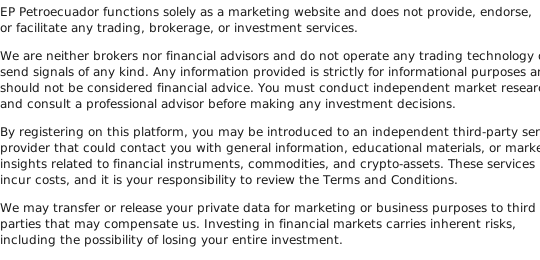
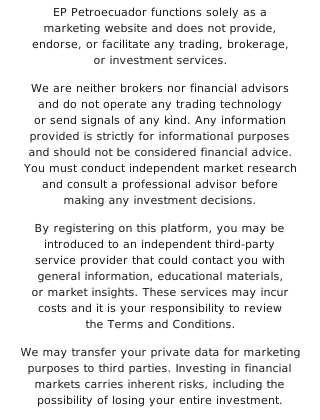
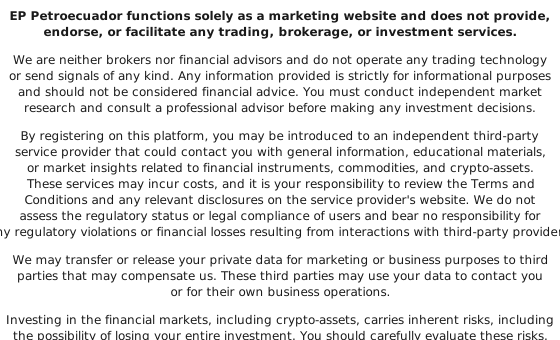
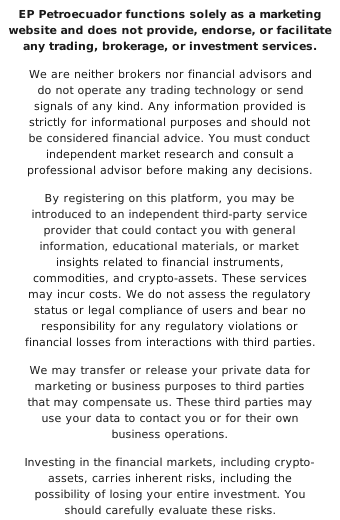
This website functions solely as a marketing platform and does not provide, endorse, or facilitate any trading, brokerage, or investment services.

Read More
Disclaimer Disclaimer